Since creating the “Constellation Survivors” website in February 2004 I have received a fairly constant stream of questions about Constellations and Constellation "Survivors". I have tried to answer these questions and have, at times, consulted with Constellation “guru” Peter J. Marson on some of the tougher questions. A friend recently suggested that I create a forum to share these questions with website readers and I agreed it sounded like a great idea. While the ideal solution would be an interactive forum, unfortunately my limited html programming skills preclude this as a possibility. Until I can master the necessary skills to make this happen, I have created the following “Q&A Forum” to address questions from readers. Please email me your questions and I will make every effort to answer them and post them on this forum.
Q & A FORUM
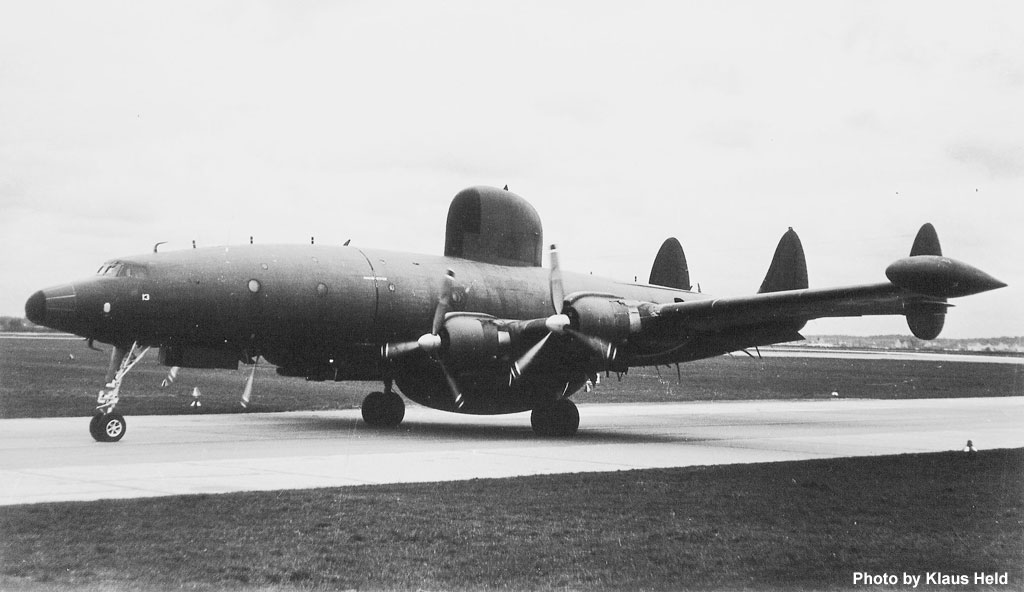
QUESTION – "MYSTERY WILLY VICTOR AT MUNICH-RIEM AIRPORT" – Stefan Roehrich – August 26, 2023
I've recently received the attached photo of an EC-121, taken by Klaus Held at Munich-Riem Airport, Germany on 14 April 1966. There is only a tiny "13" visible on the front of the fuselage and, if there are any markings on the tail, they are obscured by the wingtip. I've searched around on the web, but so far I haven't found anything conclusive. Could this be 52-3413 or maybe USN 141309? This is pure conjecture on my part because 141311 has "15" on the front fuselage? Klaus told me it was a lucky shot as the plane only landed, stayed for a few minutes, and took off again. It's also the only EC-121 I have a record of at Riem.
ANSWER
Stefan,
Peter J. Marson identified the mystery aircraft as EC-121M/WV-2 BuNo 131391 c/n 4311, which was assigned to VQ-2 Rota, Spain at the time the photo was taken. Peter noted "As they were basically "spy" planes they tended to be as anonymous as possible!" It was retired and flown to Davis Monthan AFB in August 1974 and scrapped subsequent to May 1976 with 12,146 airframe hours. Aircraft details from 2007 Air Britain Lockheed Constellation by Peter J. Marson.
Ralph
++++++++++++++++++++++
QUESTION – "BURBANK AIRPORT MYSTERY CONSTELLATION" – Ron Cuskelly – February 16, 2020
I recently acquired the attached photo of four RAAF P-3B Orions on the Burbank flightline in January 1968. Can you identify the Connie in the background?
ANSWER
Ron,
I didn't have an answer re the aircraft's identity so I contacted Constellation authority Peter J. Marson. Peter identified the aircraft as former Eastern Air Lines L749A N107A. Eastern retired the Connie in 1960 and it was sold to California Airmotive in 1961. It was leased to Admiral Airways in June 1961 and again in April 1962 before being sold to Great Lakes Airlines. Stored in Admiral colors at Burbank by July 1963, the aircraft was sold to Trans California Airlines for spares and finally broken up at the airport between February and June 1969.
Ralph
Many thanks to Peter for his quick response to my inquiry. Aircraft details from 2007 Air Britain Lockheed Constellation by Peter J. Marson.
++++++++++++++++++++++
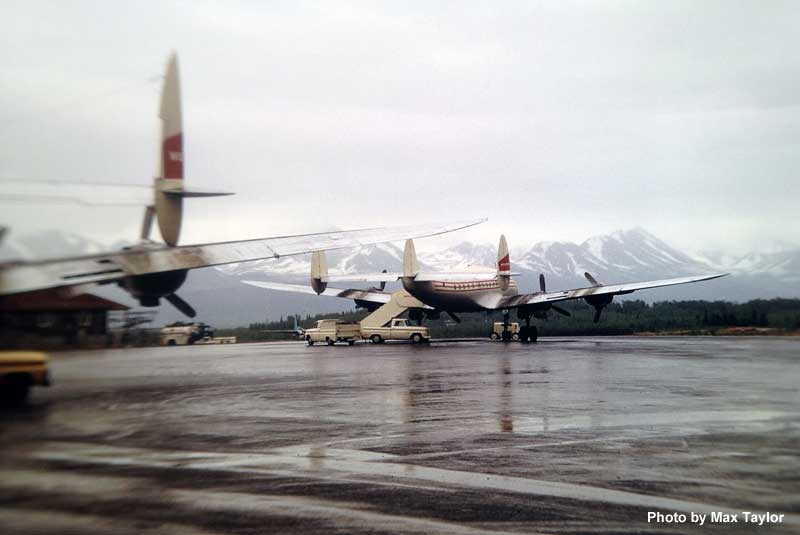
QUESTION – "MYSTERY CONSTELLATIONS AT THE ANCHORAGE AIRPORT TERMINAL IN 1968" – Max Taylor – January 5, 2019
On my way back from Vietnam on May 28, 1968 we flew from Camron Bay to Japan and then on to Anchorage, AK before our final leg to Ft Lewis, WA. While in Anchorage we got off the plane and, while walking around the terminal while our aircraft was refueled and got a change of crew, I looked out of the terminal windows and shot this image. Unfortunately it does not show any registrations but is proof of two Connies on the ramp in Anchorage at the time. I thought I’d pass this photo, taken through the glass window on a rainy day (not the best image) along for historical reasons. Also, you may be able to recognize the livery on these two Connies. I really have no idea who they belonged to at the time.Also, while on vacation years ago and driving around the airport in Auburn, ME I spotted to two Connies that were then sitting at the northeast side of the airport. Many years later I met an old gentleman who had flown a “MATS Connie” into Willow Run Airport in Ypsilanti, MI and he told me that he had flown both of those aircraft to the Auburn airport. He told me that he was, at the time, one of only five pilots certified in a Connie. I doubt if he is still flying as he was quite elderly then, about 20 years ago.
I have always been fascinated by the Connies but unfortunately there aren’t any near my home in Las Vegas. I think the closest one is in Chino near where I grew up and there is also one at an airfield on the west side of the road to the Grand Canyon about half way north from Williams.
Many thanks to all involved in trying to keep the remaining Connies flying. I understand that there is one in China, CA that is being restored. I used to fly in and out of the Chino airport back in 1968—69 when I got my pilots certificate out of Cable Airport in Upland where I grew up. Where is Bill Gates when you really need him to back such projects? Can you imagine a Connie decked out in a Microsoft livery or even Apple?
ANSWER
Max,
Thanks for your email and the great photo. The aircraft are two Western Airlines L749A model Constellations. Western acquired six former Pacific Northwest Airlines L749A Constellations when it bought that airline in July 1967. While the aircraft were painted in full Western colors, Western only flew them until November 1968 when they were replaced by Lockheed Electras. Western had the distinction of operating the last regularly scheduled Constellation flight on 26 November 1968.
The two Constellations at Auburn were actually L1649A Starliner Super Constellations and both have survived. The pilot you spoke to at Willow Run was Frank Lang who flew the MATS Connie from about 1992 until 2005, when he flew it to Korea for display in Air Korea colors. Frank Lang actually did fly the two Starliners into Auburn, ME with owner Maurice Roundy flying co-pilot. Maurice’s third Starliner N974R never made it to Maine and is currently on display at Kermit Weeks Fantasy of Flight in Polk, FL. Frank also flew that airplane to Kermit’s museum airstrip from Sanford, FL. The two Auburn Starliners, N7316C and N8083H also survive, with N8083H recently restored and now sitting at JFK painted in TWA colors waiting to become a cocktail lounge adjacent to the new hotel being built adjacent to the old TWA terminal. N7316C was subject of a 10-year Lufthansa "better-than-new restoration" project that they pulled the plug on in March 2018 after spending upwards of $200M on. They disassembled the airplane and shipped most of it back to Germany. Only the fuselage and wing remain in Auburn and will be shipped to Germany in 2019. Lots of info about both aircraft in my Constellation News page. Just scroll down for the news pieces. Here’s links to some history on the MATS Connie and the two Auburn Starliners.
MATS Connie history
N7316C History
N8083H History
Ralph
++++++++++++++++++++++
QUESTION – "DOCUMENTARY ABOUT A SUPER CONNIE RESTORATION" – Bill Fowler – August 21, 2016
I love your site as I'm a long-time lover of old propeller airliners. I'm wondering if you remember the name of a show around 20 years ago. It was about some retired Australian airline mechanics bringing a long parked Connie back to life to return it to Australia. I can't recall if it was on PBS or another network. If you happen to remember the name of the show/program or link, I'd love to know it. Thanks for any help.
Kind Regards
ANSWER
Bill,
The aircraft was former USAF C-121C 54-157 that was stored at Davis Monthan AFB for many years. It is now in Australia registered VH-EAG with the Historical Aircraft Restoration Society (HARS) and is one of only two airworthy Constellations. The name of the video was An Affair with Connie and it documented the restoration and flight back to Australia. The DVD is still listed for $27.27 (Australian) on the HARS online shop.
Ralph
++++++++++++++++++++++
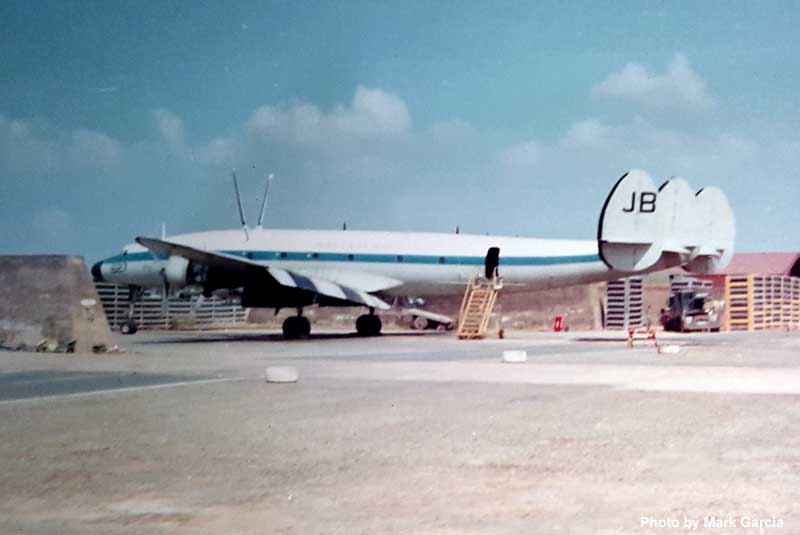
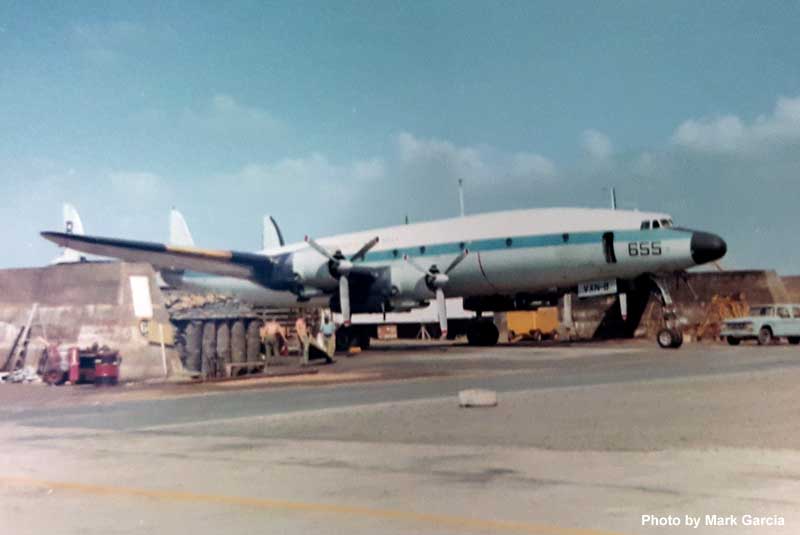
QUESTION – "IDENTITY OF TWO SUPER CONSTELLATIONS AT TAN SAN NHUT AFB IN 1969-70" – Mark Garcia – April 3, 2016
I recently found pictures of two Navy Super Constellations I took while stationed at Tan San Nhut AFB, Viet Nam, 1969-1970. These two planes were across the taxiway from our RB-57’s. I was in the Air Force 460th avionics group maintaining the optical cameras on the RB-57’s. I labeled the images EC-121 but I do not know if that is the correct designation for these two planes. I have not looked through all the images on your website; you may be better prepared to determine if these two planes are survivors.
Best RegardsANSWER
Mark,
The aircraft were NC-121J BuNo 131627 and 131655. They served with “Project Jenny” providing radio and TV programming to the troops stationed in South Vietnam. Both were scrapped after being retired in the 1970’s.
Ralph
++++++++++++++++++++++
QUESTION – "LOGO ON WORLD SAMPLERS STARLINER N7321C AND REQUEST FOR PHOTO OF CANAIRELIEF L1049H CF-NAJ” – Jörg Weier – August 10, 2015
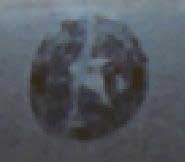
I am a fan of your Connie website for many years and today comes my first mail for the Q &A forum. L-1649A Starliner N7321C cn1024 was a real globetrotter when flying for World Samplers Inc. during the mid-sixties. It had a smart dark blue color scheme and a tiny blue logo with something white in the center. The logo appeared six times on the tail, two times under the cockpit and one time near the main entrance door. No photo in a book or in the net was sharp enough to solve the “secret.” Can you help?
Canairelief L-1049H CF-NAJ c/n 4828 crashed whilst landing at Uli airstrip in Biafra in August 1969. In Michael Drapers book “Shadows” is a very small color photo of CF-NAJ complete with dark blue roof and Peanuts nose art. Is there anybody out there who has a full frame picture? Even black and white would help.
Kind Regards
ANSWER
Jörg,
I contacted Paul Zogg, who has a photo of N7321C posted on his website, asking if he had a higher resolution version showing more detail. His response was “Unfortunately I do not have a detail shot of the logo. The resolution of my existing pictures and slides doesn't reveal the secrets.” I've posted a couple of blown up photos of the logo that Paul sent me and hopefully this will jog someones memory and they will email me an answer to your question.
Ralph
+++October 30, 2021 Update+++ I recently received an email from Michael Zoeller with his rendition of the World Samplers logo. "I have an item from World Samplers which shows the logo and I have redrawn it for my own amusement. The squiggle next to the star is supposed to be a cactus, but even on the original it just looks like a blob." Many thanks to Michael for his efforts.

++++++++++++++++++++++
QUESTION – "IDENTITY OF TWO SUPER CONSTELLATIONS IN STEPHENSVILLE, NEWFOUNDLAND” – Danny Gillam – July 13, 2015
If you could shed some light on this, I'd appreciate it. Until the mid 80s two Connies sat on the westend of the former Ernest Harmon AFB property. One in a wing dock and the other outside the hangar. Both were painted in freight airline markings. I recollect that a private buyer purchased both, one as a donor for the other and restored it to flying condition. If I am correct, this aircraft was flown to an unknown destination and what remained of the other was loaded on a flat bed and hauled away as spares or scrap. I would like to know the fate of this Connie ie, static display/airworthiness/disposal/etc.
Cheers
ANSWER
Danny,
The two aircraft were L1049H Super Constellations CF-BFN and C-FBDB. Both were former Flying Tiger Line aircraft (N6912C and N6922C). Stored at Stephenville from September 1974, CF-BFN was made airworthy and flown to Miami in December 1978, where it was given an overhaul and restored to N6922C. It was sold to Dominican operator AMSA in June 1988 and registered HI-542CT. On February 3, 1992 it was damaged beyond repair at the Rafael Hernández Airport in Aguadilla, Puerto Rico, when hit by a runaway DC-4. AMSA abandoned the aircraft and it is still stored at the airport in poor condition. Here’s a history of the aircraft and a recent newspiece.
Ralph
++++++++++++++++++++++
QUESTION – "WHEN DID TCA PAINT THE UPPER FUSELAGES OF ITS SUPER CONSTELLATIONS WHITE?” – Pat Rogoski – January 1, 2015
Love your Connie Survivor site. I'm trying to find out when TCA (Trans Canada) went to the white top fuselages. I just know it was after they did conversion work to them. I want to know if they ever flew with the long nose and tip tanks in overall bare aluminum. If so, which one(s).
Thanks
ANSWER
Pat,
After doing a bit of research on my own, I came up empty and realized it was time to bring in the big guns to help answer Pat’s question. I emailed Peter J. Marson for assistance. Peter is the internationally recognized expert on Lockheed Constellations and has an encyclopedic knowledge of the aircraft and its history. He did not disappoint and I received the following response a few days later.
Your query is not quite as straightforward as I first thought. Fortunately I made notes on my visits to London Airport in the Connie era, which helped.
The TCA 1049Cs & Es were delivered with silver cabin roofs - ie up to & including CF-TEU & TEV (delivered April 1956). The first to be delivered with white cabin roofs were the Super Gs CF-TEW & TEX in November/December 1957.
The white cabin roof (+ white fins) were painted on the 1049C/E fleet from mid-1957. The first time I noted this was 12th June 1957. In May 1957 the Super Connies I saw still had a silver roof, whereas from 12th June - ie later in June & July all had the white roof. It is possible that one or two aircraft were painted earlier than my first report, as I only managed a couple of visits a month to LAP (it was a journey of 2-3 hours each way!)
The next stage was in fact the upgrading of the 'Es (& some of the C's via the 'E mod - see my book) to a 'G standard with the fitting of tip-tanks. This happened at the same time as the delivery of the Super Gs CF-TEW/X. For the first few visits during December 57/January 58 I recorded some of the earlier fleet with grey tiptanks - ie the aircraft flew with the tiptanks fitted, but they were not painted with the TCA emblem and lines until later - my first record was on 21st December 1957 in this format.
The final stage was the fitting of the storm-warning radar nose. Only CF-TEW/X (+ later the two 'Hs TEY/Z) were delivered with the radar nose. The other aircraft were gradually fitted with a radar nose during the spring of 1958. The two 'Hs, by the way, never had tiptanks fitted with TCA.
Many thanks to Peter for his detailed answer and prompt response.
Ralph
++++++++++++++++++++++
QUESTION – "WERE R2800 ENGINES EVER INSTALLATED ON THE CONSTELLATION?” – Harry Wismer – October 28, 2013
Thanks for all the updates on the Connies. Not being a Connie enthusiast, I have a question for you. Somewhere, sometime I read that Connies were produced with engines other than R3350's. Either R2800 or R4350 engines. Which one and when? Did the Connie ever have Curtis Electric props?
Thanks
ANSWER
Harry,
Peter Marson’s book “The Lockheed Constellation” notes that the prototype C-69 aircraft (c/n 1961), originally equipped with R3350 engines, was fitted with R2800 engines by the USAAF in September 1945. The aircraft was used for engine testing until December 1945, when it was flown to Minneapolis, MN for icing testing between January and March 1946. The aircraft was sold to Howard Hughes in mid-1946 and later bought back by Lockheed in May 1950 for conversion to the Super Constellation prototype. At this point, the four R2800 engines were still installed. The aircraft retained the R2800 engines in the #2 and #3 positions until it was scrapped in the early to mid-1960’s but the #1 and #4 positions were used to test a variety of R3350 engines and the newly developed T-56/501 turboprop engine. Various propellers were also tested in the #1 and #4 positions. No R4360 engines were ever installed on a Constellation, although 4 military aircraft were equipped with turboprop engines. The airplane was a great performer but the jet age was right around the corner and the military opted not to pursue this option.
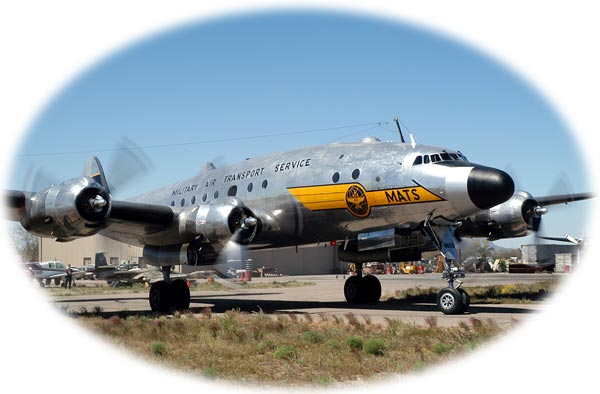
Curtis Electric props were an option on both the L749 Constellation and L1049 Super Constellation series aircraft. All ten of the short body C-121A aircraft were equipped with Curtis Electric props including the “MATS Connie” (48-609/N494TW) and the Dutch Aviodrome Constellation (48-612/N749NL). The Dutch aircraft was converted to Hamilton Standard props after arriving in Holland because the MATS Connie folks had the only spare set of Curtis Electric props and weren’t willing to part with them. Hope this answers your questions.
Ralph
++++++++++++++++++++++
QUESTION – "UNIDENTIFIED CONSTELLATION” – Pete Fothergill – February 11, 2013
I’ve recently purchased a slide scanner and am now in the process of scanning all my old slides (1970-1984) into my PC. My interests are mainly airliners & I’ve come across a picture you may be interested in, taken I think in 1982. That year I was on vacation trip from here in the UK to Florida, Louisiana, Mississippi & Georgia, but as to where I took the picture, I’m afraid I have no idea. Perhaps you may be able to help with the location & identity of the aircraft. If not, please feel free to use the picture anyway.ANSWER
Pete,
The photo was taken in New Orleans and the aircraft is L049 N864H c/n 2068. According to Peter J. Marson's Lockheed Constellation book, it was originally delivered to KLM as PH-TAU in May 1946 and sold a few year later to Capital Airlines in July 1950 as N86531. Retired by Capital in December 1960, it flew for a number of small airlines over the next 10+ years. It was flown to New Orleans in early 1973 for use as the “Crash Landing Bar/Nightclub”. Then as an attraction at the “Millionaires Club” by late 1975 followed by the “Crash Landing Disco” in about 1981 and finally the “Village Place” in 1982. It was scrapped a year later in 1983.
Ralph
++++++++++++++++++++++
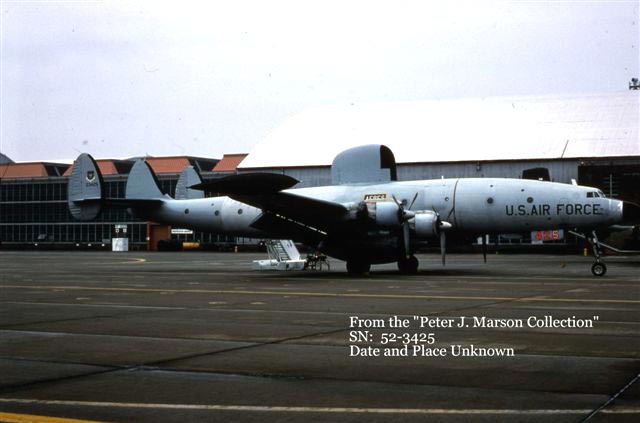
QUESTION – "DATE AND LOCATION OF EC-121T 52-3425 PHOTO” – Ernie Newman – May 11, 2010
This image is from the "Peter J. Marson" collection. This Connie was assigned to the AFRES 1 Aug 1976, with stops at Keflavik, Homestead and Sacramento until it was dropped from the Air Force inventory 30 Sep 1978. Is there anyone out there that knows where this picture was taken? Please send your reply to colorockymthi@comcast.net This beautiful aircraft is now the centerpiece of the airpark at the Peterson Air and Space Museum, Peterson AFB, CO. www.petemuseum.orgANSWER
If anyone has an answer for Ernie, please email him directly at his email address and please copy me so I can include the information on this website.
Ralph
++++++++++++++++++++++
QUESTION – "SUPER CONSTELLATIONS OPERATED BY LOCKHEED” – Peter Merlin – October 29, 2009
I’m trying to track down some information about a Super Constellation that was operated by Lockheed during the 1960s. Between January 1961 and May 1968, Lockheed operated three Connies from Burbank as personnel/cargo transports. The first aircraft in the fleet was the L-1649A prototype (registered as N60968 and later N1102). In July 1963, Lockheed leased L-1049H (N6922C) from Air America. Kelly Johnson lists a third aircraft as an L-1049G but the only pictures I have seen (bad photocopies) don’t show the tail number. I am trying to find the date that the L-1049G was added to Lockheed’s fleet, the airplane’s registration number, and eventual disposition. If you can help or point me in the right direction, I would be grateful. Thanks!
ANSWER
Peter,
Lockheed operated the following Constellations.
(1) L1649A N1649/N90968/N1102 (c/n 1001) – 1959 thru 1970
(2) L1049H N6922C (c/n 4825) – 1963 thru 1970
(3) L1049G N9723C (c/n 4680) – 1963 thru 1970
(Source – The Lockheed Constellation – Peter J. Marson, Air Britain 2007)
Note: N6922C went on to fly with AMSA as HI-542CT and has been stored in poor condition at Aquadilla-Borinquen Airport, PR. since 1992, when it was involved in a ground collision with a DC-4.
Ralph
++++++++++++++++++++++
QUESTION – "SQUARE TIP PROP BLADES ON CF-TGE” – Del Mitchell – June 30, 2009
I just received my latest addition of Propliner Magazine, and I see your article on page 11 of the Trans-Canada Airlines Connie CF-TGE, c/n 4544. Great article, and great pictures. I have a question. What's with the squared props? Was that a modification to that particular aircraft? I've seen squared props on other Connies, but they were usually modifications in test trials, or on the YC-121F's and RC-121D's, but I'm not familiar with commericials. Can you educate me? Thanks.ANSWER
Del,
The props on CF-TGE are authentic...they are Curtis Electric props and they were indeed installed on Trans-Canada Super Connies. Most Super Connies had Hamilton Standard props but KLM, Pakistan International, Qantas, Seaboard and Western and Trans-Canada had Curtis Electric props installed on at least some of their aircraft. Hope this helps. (Source – The Lockheed Constellation – Peter J. Marson, Air Britain 2007 pages 109 and 110)
Additional information received from Peter Marson on August 12th. "Curtiss Electric had two types of props for the 1049 series with square tips, the C634S-C502 & C634S-C504 and one type with rounded tips, the C634D-A4. The two "S" types were with extruded hollow steel blades, the "D" with dural (aluminium) blades. The difference between the two with square tips were the former had fluid anti-icing, the latter was with electric de-icing. The "D2 type also had fluid anti-icing."
Ralph
++++++++++++++++++++++
QUESTION – "SOUTH AMERICAN CONSTELLATIONS” – John MacDonald – March 29, 2009
Back in the early 80's we went down to Peru and Ecuador. I clearly remember there being at least three Constellations at the end of one of the runways, but I can't remember which airport. I am pretty sure I have some pictures, but if so, they are in storage. Did you ever hear about Constellations in either Peru or Ecuador? Thanks
ANSWER
John,
Most likely it was Lima, Peru. There were no Constellations or Super Constellations registered in Ecuador but quite a few registered in Peru flying for LANSA, RIPSA, Trans Peruvana and COPSIA. Many of these aircraft were stored in Lima after being retired and there probably would have been some remaining in the early 1980's.
Ralph
++++++++++++++++++++++
QUESTION – "EASTERN AIRLINES AIR SHUTTLE SUPER CONNIES” – Norm Bernstein – March 26, 2009
I wandered into your website today… very interesting! I was wondering if you had any knowledge of the use of Constellations by Eastern Airlines, in the mid to late 1960’s, on their ‘shuttle’ service between either Newark NJ, or LaGuardia, NY, and Boston. My sister entered college in Boston in 1966, and as I dimly recall, some of the aircraft used on those shuttle runs were indeed Constellations. I entered college in Boston in 1969, and often took the shuttle between Newark and Boston, but the Connies were gone by then… I think. Any clue as to when Eastern Airlines discontinued the use of Constellations on that service… and where those planes ended up? Thanks
ANSWER
Norm,
Eastern Airlines began “Air Shuttle” service on April 30, 1961 with Super Constellations between Boston, LaGuardia, Newark and Washington, DC. These aircraft continued flying the “Air Shuttle” until February 14, 1968 when L1049G N6232G flew the last Super Connie flight from Boston to Newark and then on to Washington, DC. While replaced as front line aircraft by Lockheed Electra’s in September 1965, the Super Connies continued to serve as “second section” aircraft for another couple of years. After retirement, most were flown to Southern Florida for storage at the Miami, Fort Lauderdale and Opa-locka airports. While most of the L1049 and L1049C aircraft were scrapped in Florida during the early 1970’s, quite of few of the L1049G aircraft were sold to California Airmotive and flown to Fox Field in Lancaster, CA where they met a similar fate. Since the aircraft were passenger aircraft and not freighters, they were essentially worthless on the second-hand market and very few had careers beyond Eastern. Sadly, none of these aircraft survive today.
Ralph
++++++++++++++++++++++
QUESTION – "TURBOPROP POWERED YC-121F AND R7V-2 SUPER CONNIES” – John Bartlett – March 23, 2009
Does anyone have any information on the YC-121F and R7V-2 Pratt &Whitney T-34 Powered Connies? Any pictures after they left military service? Are they still around today? Thanks
ANSWER
John,
Sorry to say but none of the four aircraft still survive and I do not have any photos after the aircraft left military service. Here’s a brief history of each aircraft.
YC-121F 53-8157 and 53-8158
The Flying Tiger Line acquired the two YC121F's and also two former LAV L1049G's, YV-C-AME and YV-C-AMI (c/n's 4636 and 4674 respectively). The fuselages of the two YC121F's, being basically identical to the civilian L1049H (apart from the passenger windows, which didn't really worry Flying Tiger, being an Air Cargo Company) were then mated to the wings, power plants and tail units of the 2 L1049G's. 53-8157 was combined with YV-C-AMI, re-registered N9746Z and shortly thereafter N173W. 53-8158 was combined with YV-C-AME, re-registered N9794Z and shortly thereafter N174W. Both N173W and N174W ended up flying for North Slope Aviation Company in Alaska. N173W was written off in June 1973 by Aviation Specialties (its final owner) and N174W was written off in May 1970 by North Slope. For additional details, see David Wood's post on the Propliner.Com discussion website. (Source - David Wood/The Lockheed Constellation – Peter J. Marson, Air Britain 2007)
R7V-2 BuN 131630 and 131631
BuN 131630 was retired to Litchfield Park in December 1956 and struck off record in April 1959 with 109 total hours. It remained at Litchfield where it was cannibalized for spares. The rear cargo door was cut out and used for converting L749A N5596A (c/n 2619) to a cargo aircraft. BuN 131631 was converted by Rohr Aircraft in late 1956 to Allison 501D engines with Aeroproducts 606 4-bladed props for the engine test program for the Lockheed Electra. (120 hrs TT). After being damaged at Palmdale, CA it was struck off record (882 hrs TT) in July 1959. Sent to Litchfield Park for storage it was sold to California Airmotive as N7938C in May 1960. Fuselage and other parts were used in the rebuild of L1049G N7121G (c/n 4648) in 1960. Remainder of aircraft scrapped at Litchfield. (Source – The Lockheed Constellation – Peter J. Marson, Air Britain 2007)
Ralph
++++++++++++++++++++++
QUESTION - "MYSTERY EVERGLADES SUPER CONNIE AND AVIODROME CONNIE" - Peter Ferraro - February 27, 2009
I recall as a young boy going to visit my grandparents who lived in Naples FL. My family flew into Miami and then drove across what I believe was US 41, known as the Tamiami Trail. I'm guessing that this was around 1970 or so, so my memory is rather vague, but I do distinctly remember a Connie that was along the road mounted on top of a gas station or restaurant or something like that. I fairly sure that it was the Tamiami Trail and not the interstate 75. Do you have any info on that airplane and what perhaps ever became of it? I think also I recall seeing a picture of it in a magazine sometime later as well.
Another Connie memory as well, although this one is much clearer. I was flying for the old Business Express airlines back in the early 1990's. This one particular night we left Boston late in the evening headed for Presque Isle, Maine for a layover. The weather was foggy, so we shot an approach and landed north. As we turned off the runway, my jaw absolutely dropped as the landing lights illuminated in the murk, of all things, a triple tail sitting on the ramp! I was shocked to say the least. Luckily, the airplane was still on the ramp the next morning when we went back out to the airport to return to Boston. I borrowed one of the ramp tugs and went around to where the airplane was sitting. It turned out to be the Conifair 749 that I believe went to AZ for restoration and then to Amsterdam. The crew was there and I chatted with them for a bit. They were stuck waiting for the weather to clear as well as dealing with a fuel sump drain valve that wouldn't shut. I recall the mech, drenched with avgas running down his arm, trying to close the valve with a screwdriver without success. It was a cold, raw day so he wasn't having any fun. They let me take a quick look in the cockpit, which as a Connie lover I had to do. I was struck that these guys were flying all the way to Arizona with VFR sectionals! Unfortunately, it was getting closer to departure time so I had to scoot. I would have loved to have spent alot more time talking to them. As I drove away on the tug, that mech, cussing a blue streak, was still struggling with that fuel drain too.
ANSWER
Peter,
The aircraft you describe is L1049G c/n 4617, which was delivered to the Portuguese flag carrier TAP as CS-TLB in July 1955 and retired in mid-1967. It was sold to International Aerodyne and flown to Miami, FL in September 1967 and registered N4624 in April 1969. Sold to Air Cargo Operations Inc in June 1969 and to Leasing Consultants the same month, the aircraft never flew again but was used instead for spares. Disassembled in October 1969, the aircraft was transported to Everglades, FL and by September 1971 was placed atop a restaurant at the Dade Collier/Oasis Airport, Tamiami Trail. The restaurant closed and the building was later used as a garage with the aircraft remaining there until early February 1978 when the garage closed. The aircraft was taken about a mile away and cut up for scrap in February 1978. (Source – The Lockheed Constellation – Peter J. Marson, Air Britain 2007) Here's a link to a photo of the aircraft on the Airliners.net website.
The aircraft you saw at Presque Island, Maine was indeed former Conifair L749A (C-121A) N749VR being ferried by a Constellation Group crew from Mont Joli, Canada to the group's headquarters at Avra Valley Airport (now Marana Northwest Regional Airport) near Tucson, AZ in September 1994. Stored at Avra Valley without its props for almost seven years, this aircraft was restored by Dutch Aviodrome volunteers and mechanics from The Constellation Group between March 2001 and September 2002. The aircraft was re-registered N749NL and flown to The Netherlands in September 2002. It is currently painted in 1950's era KLM colors and is stored in airworthy condition at the Aviodrome's facility in Lelystad, The Netherlands. The Aviodrome is currently working through the FAA bureaucracy to get a flight crew certified to fly the aircraft during the 2009 European airshow season. Here are some links from my website with some additional information about the aircraft that you might find interesting.
N749NL History
N749NL Photo Metamorphous
Connie's Comeback From the Cockpit
Restoration of L749A N749NL
I hope this answers your questions.
Ralph
++++++++++++++++++++++
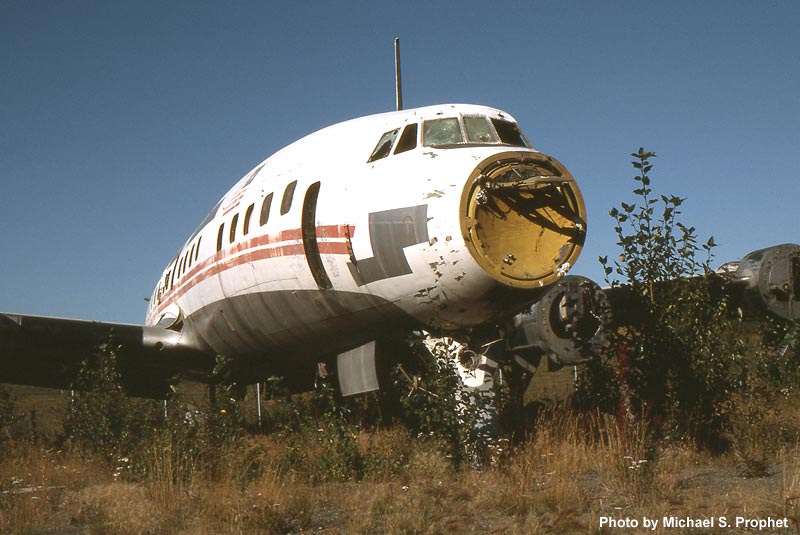
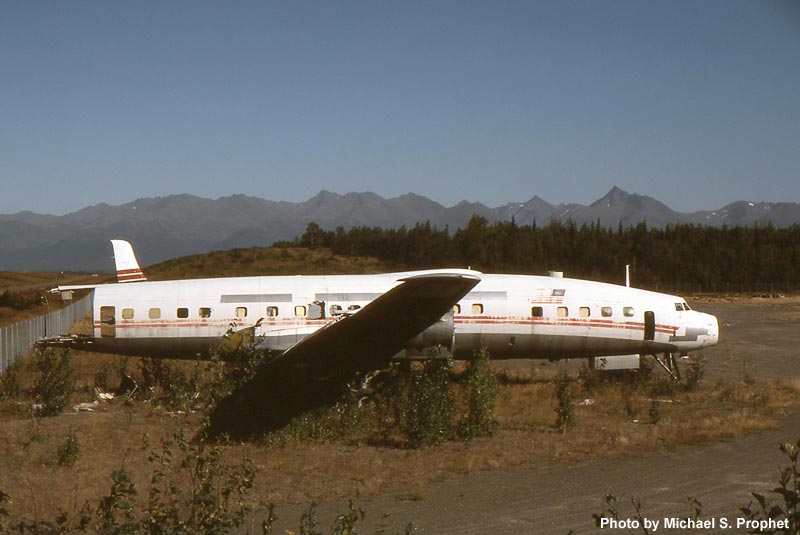
UPDATE - "ANCHORAGE FIRE DUMP CONNIES" - Michael S. Prophet - December 24, 2008
I was browsing your website and landed on your new feature questions/answers. I thought it would be nice to show you these two scans, which I made on my first trip to Alaska in August/September 1987. I arranged to be escorted by the ANC airport ramp control to the remote storage/fire training area area where the TWA Staliner and DC-6 spent their last days! The L1649 was the N7315C and the DC-6 was the N65L ex RAA.ANSWER
Michael,
Thanks very much for the two very interesting photos. By the time I made it to Anchorage in 2005, these two aircraft were long gone and had been replaced in the firedump by an Electra! I will include your email and photos in an update to the website. This will probably not happen until next week since my FTP connection is “broken”, as the result of a server crash last week, and won’t be back up and running until next week.
Ralph
++++++++++++++++++++++
QUESTION - "C-121C 54-0153" - Paul Ray - December 24, 2008
Regarding the subject Connie (54-0180) at Charleston AFB, the hierarchy at Charleston in 1985 wanted the City of Charleston 40153 colors on the bird. I believe the actual 40153 went down in the Azores. It was a great treat flying to old gal back home. I was 15 years non current but made one of my best landings at the end of the nonstop flight to Charleston (I cheated and only used 50% flaps). Very memorable day as it was my 19th wedding anniversary and my wife swore I loved Connie more than her. I have a couple of pictures some where of the great brake/hydraulic fire we had in the chocks following final shutdown. Easy way to make the front page of the Charleston News & Courier. Thanks for the great web site.
ANSWER
Paul,
After 7 years of service at Charleston AFB, the “real” 54-0153 went to the New Jersey ANG in December 1962. It served there until May 1973 when it was flown to the boneyard at Davis Monthan. By June 1976 it was on its belly with no engines and it was sold for scrap in March 1978. (Source – The Lockheed Constellation – Peter J. Marson, Air Britain 2007)
Ralph
++++++++++++++++++++++
QUESTION - "SPEEDPACK" - Danforth E. West - December 3, 2008
Over the years, I've seen photos of Constellations with a piece of equipment attached which I believe was called a "Speed Pack" or something like that. What it was was an auxilliary cargo compartment that was attached to the underneath of the fuselage to carry extra cargo. I know it was used by Qantas and at least one US carrier, but I've never seen it written about anywhere. Quick on/off with a special trolley. Was it successful? Who used it? Is there one or more still out there somewhere? Was it pressurized/heated/cooled? What did it typically carry? Thanks in advance for your reply!
ANSWER
Dan,
The Speedpack could be termed a modest success with 75 units being built by Lockheed. The 649 Constellation was the first model to carry the external freight container on scheduled airline service. It was developed by Lockheed engineers at the request of Eastern Air Lines and first tested on L049 Constellation c/n 1979. The Speedpack was 33ft 4in long, 7ft wide and 3ft deep and weighed 1,836 pounds empty. The payload was 395 cu ft and up to 8,200 lbs of cargo in seven compartments. A built-in electric hoist lowered the Speedpack to the ground for loading or unloading. For ease of movement on the ground, two semi-recessed wheels were mounted underneath each end of the Speedpack. Cruise speed was reduced by only 10 mph and range by 4%. Eastern and KLM ordered 14 and 7 units respectively in late 1946 and TWA, Air France and Qantas also ordered units. The four Speedpack attachment points were included on L049 Constellations c/n 2076 onward and on all L649 and L749 Constellations. (Source – The Lockheed Constellation – Peter J. Marson, Air Britain 2007)
Ralph
May 2017 Update - I recently received this interesting tidbit of information about Speedpacks from Bill Hicks. I was totally surprised that they were still being used in 1968 at the very twilight of Constellation passenger service. "In August 1968 my father and I flew on a Western Airlines Constellation from Anchorage to Homer, Alaska. All of the luggage was loaded in a Speedpack – it looked like a huge bathtub with small wheels that was bolted to the underside of the fuselage. The unloading of it in Homer was very fast and efficient. It seemed like a terrific idea for that application."
++++++++++++++++++++++
QUESTION - "ANCHORAGE FIRE DUMP CONNIES" - Steve B - November 30, 2008
What a great website you have there! Although I'm not quite old enough to have seen Connies in regular airline service, they are one of my all-time favourite planes. The elegance of the design has never been matched in my opinion. I came across your website while I was trying to track down some information about a couple of Connies I saw at Anchorage way back in February 1977. I passed through Anchorage on my way to Tokyo, and noted that I saw two TWA Connies on the fire dump there. I was trying to identify these two Connies. I have strong evidence that one of them was N7315C L.1649A (c/n 1017). Do you have any idea what the other one was? I appreciate any help you may be able to offer on this. Many thanks, and keep up the great work on the website.
ANSWER
Steve,
L1649A N7315C was definitely one of the aircraft. It was finally scrapped in 1995 after all of the usable parts were removed. The other aircraft was L1049H N6919C (c/n 4819), which was also scrapped at Anchorage some time after 1978. If anyone has a more exact date of when this aircraft was scrapped, this information would be much appreciated.
Ralph
| Page Top | Home |
----Created 14 December 2008------Updated 26 August 2023-----