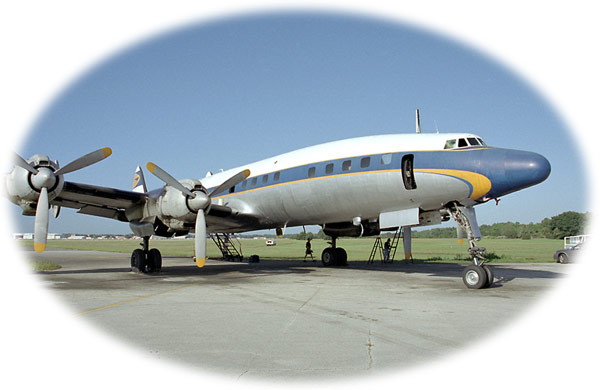
The L1649A Starliner was the outgrowth of the L1469/L1569 turboprop designs studied by Lockheed but never produced. Development of the L1649A began in May 1955 and was Lockheed’s response to the long range Douglas DC-7C that went into service in June 1956. The Starliner incorporated a totally new wing design, 3,400 hp –EA2 turbo compound engines and a fuel capacity of 9,000 gallons giving it a range of over 5,000 miles.
The first flight of the prototype was October 10, 1956 with TWA introducing the L1649A on its North Atlantic service on June 1, 1957. Sadly, this superb aircraft was developed too late and was quickly overshadowed by the early jets with only forty-four being produced. TWA was the largest operator with twenty-nine aircraft with Lufthansa and Air France also taking delivery of new aircraft. Most were out of front-line passenger service by 1963 with a number being converted to freighters and many going to second-tier operators and travel clubs. A few operated as freighters in Alaska into the late 1970’s but all commercial operations ceased by the early 1980’s.
SURVIVORS
N7316C c/n 1018--->Purchased by Lufthansa December 2007 for restoration. Project abandoned in March 2018 after the expenditure of $200M. Aircraft disassembled for shipment back to Germany. Departed the Port of Portland on September 17, 2019 for Bremen, Germany, where it is currently stored disassembled in a warehouse. Fuselage moved the airport at Paderborn, Germany during the evening hours of 22-23 February 2021. By 2022 all components less engines stored in Paderborn. Engines stored at Lufthansa facility in Hamburg.
N8083H c/n 1038--->Purchased by Lufthansa December 2007. Restored in period TWA colors and moved to JFK Airport in October 2018, where it is the centerpiece and cocktail lounge at a hotel adjacent to the former TWA terminal
N974R c/n 1040--->Purchased by Lufthansa December 2007. Donated to Fantasy of Flight Museum, Polk City, FL and currently stored
ZS-DVJ c/n 1042--->Fuselage moved to SAA Museum in Rand, South Africa October 13, 2017. Reassembly completed fall 2019
CREDITS AND SOURCES
The Lockheed Constellation Series, Peter J. Marson, Air-Britain Publication, 1982
Piston Engine Airiner Production List, A.B. Eastwood and J. Roach, TAHS, October 2002
Lockheed Constellation, Stewart Wilson, Notebook Publications, 2001
Propliner Aviation Magazine
| Page Top | Home |
----Created 15 January 2004------Updated 10 February 2022----